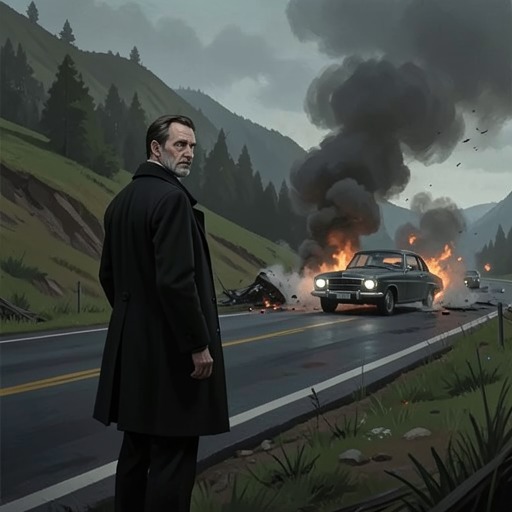
Donald Christiansen’s grief and alcoholism
The Sun is Also a StarDonald Christiansen’s grief and alcoholism turn private bereavement into a danger that reaches other people. A former insurance actuary accustomed to calculating the cost of loss, he cannot make his daughter’s death measurable or contain its consequences: over two years, grief has undermined his marriage, health, emotional life, and sobriety. His impaired driving nearly injures Natasha Kingsley and then strikes Jeremy Fitzgerald, making his loss part of the circumstances that force another character to reconsider his life.
Identity and Background
Donald once worked in insurance, where his job was to assign prices to unwanted and unexpected events. He carries that professional habit of calculation into his understanding of catastrophe: he knows actuarial estimates for human deaths in airplane crashes, car accidents, and mining disasters. This knowledge gives him a vocabulary for pricing loss, but not a way to master it. The death that matters most to him is his own daughter’s, and no table can make that personal loss commensurable with a payment.
The narration establishes the depth of that contradiction through his first response to his daughter’s death. She was killed by a driver who was texting, and Donald’s first thought was what the driver’s insurance company would pay. The detail does not suggest that he loved his daughter less; rather, it shows how thoroughly his work’s language of valuation had entered his thinking, even at the moment of bereavement. The calculation offers a measure where there is no adequate measure, while also exposing how little such a figure could account for what he had lost.
Grief and the Loss of Sobriety
Two years after his daughter’s death, Donald’s grief has not receded. It has cost him his marriage, his smile, and his ability to eat, sleep, and feel enough. The accumulation matters: his suffering is presented not as one isolated feeling but as a sustained depletion of ordinary relationships and capacities. The narration also makes the loss of sobriety explicit. Alcohol is not incidental to the danger that follows; his inability to remain sober belongs to the continuing damage of his bereavement.
After nearly hitting Natasha, Donald pulls to the side of the road, turns on the hazard lights, and lays his head on the steering wheel. He touches a flask inside his coat pocket. The brief sequence places the means of drinking close at hand while showing him stop after the near miss. It does not resolve his grief or establish a recovery; instead, it makes visible the precariousness of the moment. He wonders whether people recover from losses like his and does not think they do.
Donald tries to understand what the universe might mean by taking his only daughter, but the conclusion he reaches is not that suffering has a clear purpose. He recognizes that no one can put a price on losing everything and that a single moment can destroy every future a person had imagined. His former professional framework thus gives way to a more intimate recognition: the consequences of death exceed the terms by which an insurer might value it. The thought is grounded in his own experience, but it also anticipates how abruptly other people’s futures can change around him.
The Near Miss and the Collision
Donald’s condition enters the plot through his driving. He almost runs over Natasha, who is described as not paying attention, and the encounter leaves him shaken enough to pull over. He looks away when she sees him, appears close to tears, and offers to buy her new headphones. The offer is a limited response to the immediate encounter: he can propose replacing an object, but the headphones cannot undo the danger or stand in for the larger losses the scene has brought into view.
Later, while crossing the street, Jeremy is hit by a white BMW driven by Donald, described as drunk and distraught. The car is traveling at twenty miles per hour. The impact does not kill Jeremy, but it makes him consider his eventual death and the life he is currently living. The narration connects the collision to a decisive recognition: Jeremy admits to himself that he has been in love for some time with his paralegal, Hannah Winter. Donald does not cause Jeremy’s feelings, but his dangerous driving becomes the immediate circumstance in which Jeremy can no longer defer acknowledging them.
Consequences and Narrative Significance
Donald’s actions bind the effects of grief to the lives of strangers. Natasha is nearly hit; Jeremy is struck; and, after returning to the office, Jeremy will take Hannah into his arms and briefly wonder what loving her may cost him. The sequence sets Donald’s sense of futures destroyed in a single moment beside Jeremy’s new awareness of a future he might choose. For Donald, bereavement has made the future seem vulnerable to sudden destruction; for Jeremy, the collision turns that vulnerability into a reason to recognize love rather than postpone it.
The narrative does not present Donald’s insight into loss as absolution for his conduct. His daughter’s death and the continuing damage of his grief explain the circumstances behind his drinking, but the near miss and collision show that those circumstances place others at risk. That distinction gives his story its force: he is both a bereaved father and a driver whose impairment has consequences beyond himself. His actuarial past makes the contrast especially sharp. He once priced unexpected tragedy for a living; now his own uncontained loss helps produce another unexpected event, while the people caught in its path must reckon with what remains possible afterward.